Super Sacks of SBR Rubber Crumb Infill Material
Used for infill in Sports Turf, Synthetic Lawns, Playground Areas, & Horse Riding Rings.
Crumb rubber is a finely ground, powdered rubber produced from whole tires. Our Tire Recycling utilizes both cryogenic and ambient systems to produce 250 million pounds per year of high quality crumb rubber from passenger or all black radial truck tires at four strategically located facilities through out the USA. By reclaiming more than 33 percent of the nation’s discarded tires, means we annually transform more than 110 million tires into raw materials for smart, sustainable products that improve people’s lives. Strict quality control process assures reliability and customer satisfaction in every bag.
Our specially designed rubber crumb infill with dust free rubber granules prevent "flyout", "splashing", and migration of the base so that traction, drainage and shock absorption are maximized.
- Used to provide an in-fill cushion material in synthetic turf to provide additional safety against injuries from falls from athletes & children.
- Made from 100% Recycled Tires & free of metal fibers
- Used in Synthetic Sports Turfs & Synthetic Lawns world-wide for many years.
- Product can also be added into the production of hot asphalt
- We offer the most popular style G1 for most synthetic lawn/fringe applications (See chart below for sieve passing). Particles are about the size of granulated sugar.
- G1 is in 2,000 lb commercial Super Sacks
- Most Synthetic Lawn applications require 1-2 lbs per sqyd of G1. (2,000 lb Super Sack will infill 1000-2000 sqft of Synthetic Turf).
- Same product used in Synthetic Sports Fields World Wide!
- There is approximately 28 lbs of product per 1 cuft. or 2.5 lbs per 1 square foot x 1" depth.
- An athletic field requires approximately 125 tons of crumb rubber – about 20,000 tires. (Email for special pricing & shipping on multible pallet orders)
- Use 1-2 lbs per sqft depending upon pile height and density of your turf
- For spreading large amounts of rubber crumb we recomend a commercial Top Dresser machine available at http://www.ecolawnapplicator.com See if there is a local dealer who will rent you a machine or know of a local contractor who can help you.
- Can be mixed with sand to create a more solid surface. This mixing is done by the end user, We only ship you the rubber crumb.
- No Minimum or Maximum Purchase requirements
To calculate shipping costs, add a product to the shopping cart. An orange colored "Calculate Shipping" tab will now show up on the right side of your screen in the blue area in the shopping cart section. Click on this "Calculate Shipping" and enter your zip code. Hit "Submit", and your shipping options & delivery times will now be displayed. If there is a choice, pick the option that best fits your needs.
NOTE: With the fluxuating cost of fuel and truck availability, ShopTJB will get an exact shipping cost and let you know before processing the order. (Sometimes it is higher or lower than what our system will quote.)
You will have the option to accept or cancel the order at that time. If you accept, then we will process the order and we will have the shipper will contact you prior to delivery to cordinate the delivery.
Customer/contactor is responsible for providing man-power/equipment to off-load super sack/pallet(s) at delivery point unless you request the lift gate service option. Lift Gate option is only availble for (3) super sacks or less. All other deliveries will require a machine capable of lifting 2,300 lbs. Failure to have a working machine available will result in a re-delivery charge to be paid by you prior to re-delivery.
NOTE: Lift Gate means the driver will move the order from the bed of the truck down to the ground. All deliveries are "Curbside" ONLY. The delivery drivers will not move the shipment past the curbline. Delivery trucks DO NOT come with a forklift. Truck & trailer only!
Orders to Canada may be slightly more. We will get an exact quote & contact you before processing order. Canadian customers responsible for duties & import taxes.
G1 Infill (Pan size = # of equal holes per square inch)
| Pan Size |
% Retained |
| 8 |
0-15 |
| 10 |
10-40 |
| 16 |
40-70 |
| 20 |
0-25 |
| 25 |
0-5 |
| 30 |
0-2 |
| Pan |
0-1 |
| Totals |
100% |
| |
|
** SHIPPING NOTES **
Shipping prices are subject to change from the amount listed under "Calculate Shipping". If the actual shipping price is higher, we will get a special quote & your approval before we ship it to you. The reasons are as follows:
1) Trucks (availability)
and Destination are the top factors. The gas has a FSC (fuel surcharge). I think
it is now 26%, but it changes often. The trucks are a large factor being that
there is a shortage of trucks on the road and this has been happening for
several years. Sometimes we just can not find any trucks to ship, after calling on
numerous LTL carriers.
2) Destination (or what I think the trucking business calls
“lanes”) are a crucial element in the pricing. The way it is explained to me,
truckers do not want to carry a load somewhere that they can not pick up
something on return. They want in and out quickly and do not want to wait
around. Time is money for them. There are known dead zones that do not hold much
promise for return loads.
3) The infrastructure of some states and cities (the condition of the highways).
4) If the delivery address is business or residential, that also plays into the pricing.
5) If you require a special lift-gate to unload your order, there is an additional fee that has to be charged depending upon the size of the load.
6) NOTE: The US government has implemented a new “Electronic Log Documentation” (ELD) law that has caused havoc in the transportation industry. Due to this new law, it’s harder to find trucks, deliveries are not delivering on time and prices have gone through the roof. Prices have doubled in some cases. Before processing your order, we will get an exact current price quote for your order and let you know the price. You can then decide to continue or cancel the order.
LTL shipments are at the mercy of the carriers because they have
to be trolled around with other orders and may be unloaded and loaded a couple
of times before they arrive at their destination and some truckers just find it
a trial to maneuver in residential areas. I hope I have not confused you too much. The bottom line is, shipping pricing is variable and we have no control over it. (It makes
one think that the trucking business is a profitable business to go into now
with the shortage of trucks but that is a whole nother thing). Sometimes, the cost of shipping can cost more than the materials ordered and we apoligize for that but we are not here to make money on the shipping costs. We just want you to receive your LTL order quickly and efficiently at the best rate possible. ... TED GREINER (CEO TJB-INC)
Video of a Modern Phoenix 3000 Tire Recycling Plant in operation
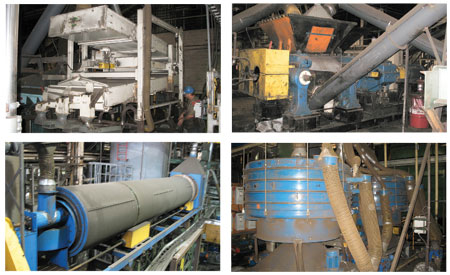
Pictures below from one of Tire Recycling Processing Plants
Frequently Ased Questions about Rubber In-Fill Materials
Will the crumb rubber float away when it rains?
No, your crumb rubber in-fill material will not float away when it rains. The high density of crumb rubber will cause it to stay in place.
Is Rubber in-fill safe?
According to the EPA, crumb rubber in-fill can be used as ground cover under playground equipment and “possesses high impact attenuation/ability to absorb the energy from falling children and objects.”
Also the use of crumb rubber on athletic playing fields as a soil additive can increase the “resiliency of the field thereby decreasing injuries.” (See additional information below)
Installation Tips
You should contact www.ecolawnapplicator.com to see if they have sold a machine to a rental center or contractor close to you that you can hire or rent the spreader from. If you do not have access to a spreader from Ecolawnapplicator then spreading rubber grinds is best done by hand. It is not possible to use a drop spreader with rubber grinds as it is with most other infill materials. The rubber crumb is too big for most drop spreaders and has a tendency of clogging the spreader. However, due to its characteristics it is much easier to disperse once it is on the turf.
To get started, fill your wheelbarrow with the rubber crumb material. Position the wheelbarrow in a needed area, reach in with both hands and grab as much as you can carry. Simply throw the rubber crumb onto the turf until you have the entire area filled. You will want enough infill material to fill in between the fibers without completely covering the tips of the fiber. It is all right if some areas have more infill than others at this point of the process. You will be brushing the infill in with a power broom or stiff bristle broom to even out the rubber grinds.
Brooming the rubber grinds is a required step to work the infill down into the fibers of the turf. It also helps disperse the infill and even out the high spots created during the application of the rubber grinds.
Using a stiff bristle broom, use short brisk strokes against the grain to work the rubber down into the fibers and to the backing material. Continue brooming until the blades are standing up and you have an even layer of rubber.
- Use short brisk strokes to work the rubber into the fibers.
- Continue brooming until the blades are standing upright.
The final step of the infill process is wetting down the turf with a garden hose. This helps drop the infill material down into the fibers and to the base. It also helps clean excess dust and debris left behind during the infill process.
Simply hose down the area side to side with your garden hose. Make sure to wet down the entire area to ensure all infill materials are settled. Repeat as often as necessary.
Current Health Concerns about Rubber Crumb Materials
(there has been a lot of news coverage so we wanted to address the concerns as best as we can with current information)
Q: What materials can be found in the artificial turf crumb rubber?
A: The crumb rubber used in artificial turf is mainly composed of recycled tires, which contain man-made and natural rubber. Certain materials have been identified in the crumb rubber, including:
- polycyclic aromatic hydrocarbons (PAHs)
- metals, such as zinc and iron
- volatile organic compounds (VOCs)
- latex
Q: Can people be exposed to the materials found in crumb rubber?
A: There are three possible ways that people might be exposed:
- Accidentally ingesting small amounts of material by placing fingers in the mouth or not washing hands before eating after playing on the fields.
- Breathing in dust created from playing on the field or from vapors given off by the turf.
- Direct skin contact with the crumb rubber.
Q: Are there any health concerns related to crumb rubber exposure?
A: Several scientific research studies carried out in the United States and Europe have examined the chemical composition of crumb rubber. These studies have assessed the potential exposures and health risks for people using turf fields. Based on these research findings, health risks are unlikely from exposure to the levels of chemicals found in artificial turf. However, there are limitations to these studies and more research is needed.
Q: Can people be exposed to these chemicals from other sources?
A: Many of the chemicals found in crumb rubber are very common in the urban environment. People can be exposed through normal daily activities including breathing air, eating food, and by getting dirt or dust on their skin. For example, rubber dust is created from the wear and tear of tires on roads and is a source of city air and soil pollution. PAHs come from the exhaust of engines, smoke from fires and cigarettes, dust-containing soot, urban soil and char-broiled foods. Gasoline, paint, building materials, trees and many other sources release VOCs into the air.
See the myths associated with crumb rubber, and compare them against the facts. "CLICK HERE"
COMPLETED
Posting: Modification to the Tires Website see: Health and
Environmental Concerns, http://www.epa.gov/epawaste/conserve/materials/tires/health.htm.
Playgrounds and Synthetic Turf
Fields
There have been concerns about the health implications of the use of recycled
tire crumb in playgrounds and in synthetic turf athletic fields. In response to
these concerns, EPA conducted a Scoping-Level Field Monitoring Study of
Synthetic Turf Fields and Playgrounds. The final report was
issued in 2009 and concluded that on average, concentrations of components
monitored in this study were below levels of concern. To supplement this study’s
limited data, EPA met with state and local representatives in 2010 to review
other available field monitoring studies including a 2010
study conducted by the state of Connecticut which concluded that
exposures and risks were not elevated (relative to what is commonly found in
outdoor air) for either children or adults using the fields.
A 2010 report
(PDF) (13 pp, 238.24 K) by the California Department of Resources Recycling and
Recovery examined the possible human health risks of outdoor athletic fields
made from artificial turf containing recycled crumb rubber with respect to skin
abrasions, bacteria harbored by the turf, inhalable particulate matter, and
volatile organic compounds. The report concluded these fields do not pose a
serious public health concern, with the possible exception of an increased skin
abrasion rate on artificial turf relative to natural turf.
At this point, EPA does not believe that the field monitoring data collected
provides evidence of an elevated health risk resulting from the use of recycled
tire crumb in playgrounds or in synthetic turf athletic fields. Ultimately, the
use of recycled tire crumb or any other playground materials is a state and
local decision.


